
Winter 2026
Way with words

Barbara Kruger: Another Day. Another Night
Guggenheim Bilbao, Spain. 24 June to 9 November 2025. Curator: Lekha Hileman Waitoller. Reviewed by John L. Walters
Barbara Kruger’s career began in magazines, but for the past four or more decades she’s identified as an artist, making works and installations for galleries and in the public realm, on bridges, buildings and taxis. For this show, at the landmark gallery designed by the late Frank Gehry, a Bilbao city tram was plastered in her distinctive typography.
As Kruger declared to Karrie Jacobs in a Reputations interview in Eye no. 5 (1992), everything she does is editorial design. Visitors were immediately confronted by images and words, a barrage of typophoto expression. The selection of words can be shaded, ambiguous, yet at the same time simple and economical. ‘Your body is a battleground’, in Futura Bold Oblique, is now more statement of fact than campaigning slogan. Though it was first used as part of a ‘women’s right to choose’ protest, it has meaning for all sides in the debate, and relevance to issues around gender, cosmetic surgery, body image and the unrealistic expectations raised by fashion and glamour media.
Kruger’s images are immediately recognisable, drawn from mid-century mass-market print media, blowing up crude, newsprint images in a way that emphasises their halftone grids.
In the 1993 work Untitled (Why are you looking at me like that?), a man’s face can be glimpsed looking back through a circular camera filter or lens held between the finger and thumb of his right hand. The image of a hand with splayed fingers recurs frequently, holding rectangular cards with pithy statements in the 1980s, and a smartphone for Untitled (Connect), decades later. Other favourites include eyes, lenses and a ventriloquist’s dummy.
So visitors to any Kruger exhibition know what to expect. Yet each show is site specific. In Bilbao, the texts were in three languages – Basque, Spanish and English. Everybody who visited had to tread on trilingual texts printed on the vinyl floor – freshly cleaned each morning – a long and winding path that linked all the spaces, an extraordinary feat of large-scale InDesign typesetting that Kruger called Untitled (Camino), 2025.
Over multiple rooms and corridors, the typographic barrage never stopped. Kruger’s work anticipated the torrent of commercial messages that now saturate every surface and screen. One room was dominated by Kruger’s détournement of rip-off advertising: she has collected examples of Kruger-like ads and memes – from home-made to ‘professional’ (the Supreme clothing brand) – and collaged them together in a delirious visual nightmare. Close by, the 1980s originals reminded visitors that her original, groundbreaking work was relatively small, often monochrome, communicating in the then current language of style magazines.
Her magazine roots are also revealed in Untitled (Artforum), 2016 / 2020, in which her extensive, critical annotations to an editor’s brief (about ‘identity’ and other issues) were laid out to create the fold-out cover of an edition of Artforum itself.
Untitled (That’s the way we do it), 2011 / 2020, is made from online images that imitate Kruger’s signature bold white text out of red. Plus an animated LED jigsaw of Untitled (I shop therefore I am), 1987 / 2019. Photo: Anders Sune Berg. Top. Untitled (Forever), 2017 / 2025, floor-to-wall quotes from Virginia Woolf and George Orwell in Spanish and Basque.

Like other artists of her generation (she was born in 1945), such as Lawrence Weiner (see Eye 29) and Laurie Anderson (Eye 76), Kruger developed work based on words through technology and scale. The display that greeted visitors to the first main room showed an electronic jigsaw of Untitled (‘I shop therefore I am’) that repeatedly assembled and fell apart . Monitors in another space animated other provocative statements (‘Admit nothing / Blame everyone / Be bitter’) while huge letters on the wall declaim ‘Verdad’ – ‘truth’ in both Spanish and Basque.
Curator Lekha Hileman Waitoller told me that Kruger wanted to go beyond the ‘white box’ approach and rise to the challenges of Gehry’s quirky interiors. ‘She likes the challenge of an unusual space. From her first site visit she knew she wanted to do something on the floor [the camino] to unite the galleries, that would differentiate the spaces and really put her stamp, her identity on the space.’
Kruger’s work embraces what we used to call multimedia, including the nine-minute, meme-laden Untitled (No Comment). In quiet corners, her sound installations, with statements such as ‘I love you’ and ‘Take care of yourself’, tempered the Guggenheim’s huge voids with a quiet, unnerving intimacy.
John L. Walters, editor of Eye, London
First published in Eye no. 109 vol. 28, 2025
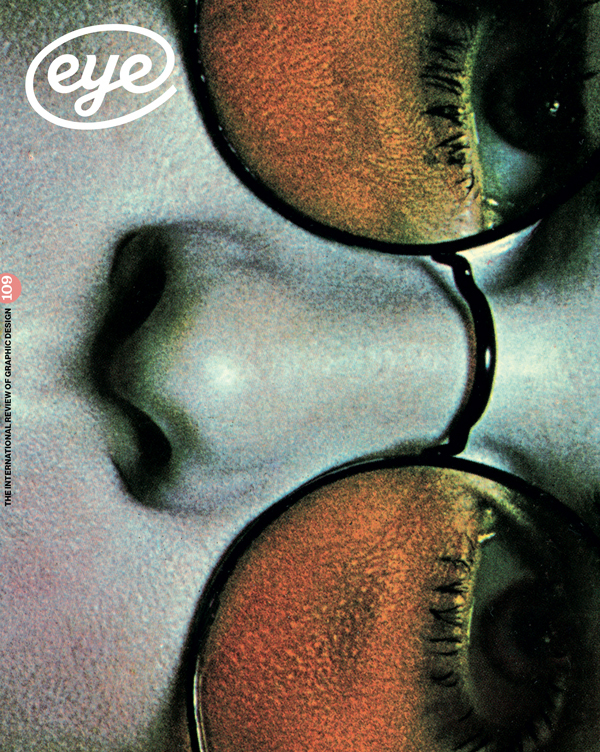
Eye is the world’s most beautiful and collectable graphic design journal, published for professional designers, students and anyone interested in critical, informed writing about graphic design and visual culture. It is available from all good design bookshops and online at the Eye shop, where you can buy subscriptions and single issues.