
Spring 2005
A graphic haven in the heart of Berlin
various designers
Paula Scher
Denise Gonzalez Crisp
Ed Fella
Jan Wilker
Hjalti Karlsson
Cyan
Daniela Haufe
Detlef Fiedler
Andrea Tinnes
Alan Fletcher
Critical path
Graphic design
Reviews
Grafic Europe
Berlin, 14–16 October 2004As one would expect of an international business venture, Grafic Europe’s second conference created a haven in the heart of troubled Berlin, flushed with warmth and humour and success. This detachment from the real ‘Berlin experience’ (you have to be a resident to know it) is significant, since location and dislocation were central themes of the conference.
Organiser Alice Twemlow put together a programme of speakers who not only had ‘star value’ but also who had the potential to address their relationship to place as well as the second theme which was craft. The implicit link was that both locality and craft are under threat from technology and the sameness brought about by cultural and commercial globalisation, both actually and metaphorically.
Presentations from more than 30 international speakers covered a panoramic, inspirational collection of work and ranged in delivery from humble, mumbly, apologetic and stern, to the cocky, passionate, witty and evangelical. ‘Locality and craft’ came and went in waves, present enough to be interesting, but not seriously engaging to the extent that one could say issues were explored in any connected way, and in spite of the evident compering skills of Aidan Walker, the breathless tempo of the programme allowed only a token gesture towards delegate participation. Perhaps this classic gala style conference format is not conducive to serious theoretical debate.
Rick Poynor (Twickenham), somewhat caricaturing a ‘pro-technology’ position, lamented the losses brought about by these networked and technological times. Pointing out that there is no substitute for a real sense of place and moment he welcomed the return of the hand-made gesture in design.
Denise Gonzales Crisp (North Carolina State University), explored metaphorical locality, illustrating how designers can shift localities of visual codes. Like Poynor, Crisp expressed the fear that we are moving away from experimentation and towards a ‘euroamericentric’ genericism; that we are too afraid of difference and strangeness. An indirect response to this was made in a closing comment by Ed Fella (Los Angeles) who asked whether we should really wish to press upon the world our single genius vision in the Modernist tradition or should the world be as it is: a plurality of the common vernacular.
Contemporary conditions of production are doubtless conducive to increasing sameness in certain areas but such claims were not specific nor illustrated. While every age has visual tendencies which cross international borders, we are intimately connected to our surroundings and this is still profoundly evident in our visual culture. Are we already at such a stage that we need to be reminded that actual presence in place is more immediate than virtual experience?
Those engaged primarily in design practice addressed location in its less difficult geographical sense.
Hjalti Karlsson and Jan Wilker (Manhattan) charmed us all with a presentation of their zany output, which seems to defy both their origins (Iceland / Germany) as well as their current location. They have created their own unique placeless culture full of humour and incongruities with delightful results.
Other presentations emphasised the direct formal impact of a specific location. Paula Scher (New York) demonstrated how crowded, tightly spaced Manhattan influences her design work with its aggressive gigantic letter forms; work that shouts in a city that shouts out loud.
John C. Jay (Wieden + Kennedy, Tokyo) treated mind-boggled delegates to a high-adrenaline performance on contemporary style in Tokyo, a fascinating nightmarish vision of the ultimate divorce of aesthetics from meaning, which – according to Jay – not only represents the centre of world fashion but is set to overturn centuries of European rationalism.
The discussion of craft was secondary but still present. Fella contextualised his career from commercial to ‘exit level’ designer within his home town of Detroit, a city built on craft trades. It was a pleasure to see such skilled hand-made work, and Alan Fletcher (London) was a complementary representative of pre-computer technical mastery. Andrea Tinnes’ (Berlin) exquisitely digitally constructed fonts and posters and Daniela Haufe and Detlef Fiedler’s (Cyan, Berlin) brilliant digitally created designs demonstrated another kind of craft. Mechanisation – I use the term deliberately since such concerns are over a century old – has caused a decline of the hand-made, but the presentations showed that quality finds new expression.
Cornelia Blatters and Marcel Hermans (COMA, New York and Amsterdam) paid scholarly attention to the themes, their collage of New York snapshots revealing how a culture of self-reliance spawns improvisation, mobility, invention and hybrid languages, an intimacy between local and global. Our established notions of craft, local / global, hand-made / technological, and traditional / modern are all characterised by contradictions and exceptions.
Alan Fletcher’s charming presentation rounded off the conference – like a very fine Bordeaux wine after a rather too large meal. I stopped taking notes, and chose simply to enjoy the pure pleasure of good design.
Jessica Jenkins, designer, Paris and Berlin
First published in Eye no. 55 vol. 14 2005
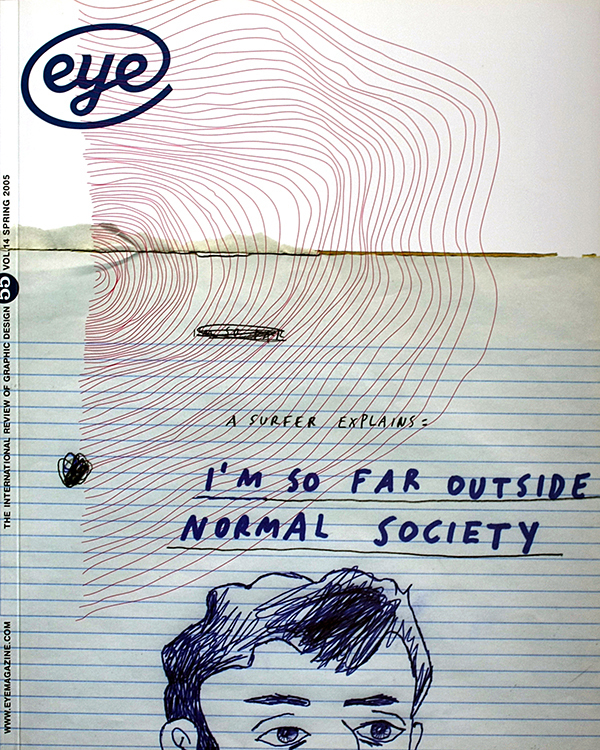
Eye is the world’s most beautiful and collectable graphic design journal, published for professional designers, students and anyone interested in critical, informed writing about graphic design and visual culture. It is available from all good design bookshops and online at the Eye shop, where you can buy subscriptions and single issues.