
Summer 2026
Print in the city
various designers
various illustrators
Edward McKnight Kauffer
Man Ray
Frank Pick
Clive Gardiner
Edward Johnston
Posters
Reviews
Events and exhibitions
Art Deco: The Golden Age of Poster Design
London Transport Museum’s Global Poster Gallery, Covent Garden Piazza, London. On until April 2027, admission from £1 to £25. Reviewed by Paul Rennie
In addition to the evident appeal of buses and trains as exemplars of urban machinery, the London Transport Museum provides a substantial resource for the study of posters and graphic communication design. Over the past ten years or so, the museum has successfully extended the scope of its displays and begun to show the systemic relationships between technology and identity across the metropolis. The museum now presents transport as urban geography manifest through system and design. The significance of the museum’s poster collection is thereby transformed, from an adjunct of machinery, to providing a significant system of communication.
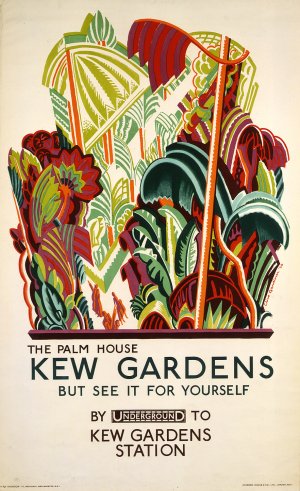
On the first floor of the building is a gallery where the museum displays a changing thematic display of posters drawn from the archive holdings at its Depot in Acton. The present exhibition shows a selection of Art Deco posters from the 1920s and 1930s – a period understood as a ‘golden age of poster design’, and coincidentally a period when the scale and reach of London Transport was greatly enhanced through geographical extension and presentational coherence under the guidance of Frank Pick. Art Deco derives from the decorative arts displayed at the Paris exhibition held in 1925. The exhibition proposed a new style for France to re-establish itself as the global leader in fashion sophistication and luxury goods through its traditions of savoir faire.
The French project recast the geometry of the ancients to speak of speed, glamour and excitement. The London Transport Museum’s exhibition marks the centenary of the original.
In contrast, Art Deco’s most successful British manifestations aim at a popular cultural appeal evidenced through the design of picture palaces, lidos, Clarice Cliff pottery and in the streamlined design of suburban furniture, railway locomotives, Underground stations and bus shelters. Today – and for many visitors to the museum – the concept of Art Deco will be largely understood as a kind of lifestyle choice familiar from the television art-direction of Agatha Christie murder mysteries.
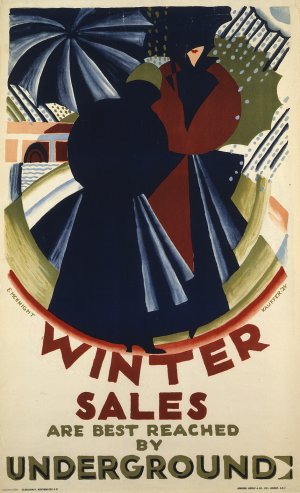
Winter Sales by Edward McKnight Kauffer, 1924. Top. Palm House, Kew Gardens by Clive Gardiner, 1926. The posters were printed by colour lithography in the standard double-royal sized portrait format measuring 25 × 40 inches.
It is entirely appropriate, in these circumstances, that the curator’s generous and eclectic selection of posters has extended to images promoting shopping expeditions, entertainments and sports events. The posters chosen display the effects of scale, sparkle and speed applied as a dramatic backdrop to the expansion of the city and the accelerating experience of metropolitan life. The gallery buzzes with the colour, excitement and energy of these images.
The poster for the Victoria and Albert Museum’s great exhibition of posters, from 1933, designed by Austin Cooper expresses the style through its combination of geometry, colour and drama. Cooper played a key role, through design and education, in developing the modern, flat-colour poster style in Britain.
Edward McKnight Kauffer, identified as the ‘poster king’ during the 1920s, is represented in the exhibition through both posters and artwork. Kauffer had begun his career, in the US, as a stage hand and scene-painter, and his posters use blocks of flat colour to create the spatial effects of theatre stage sets in two dimensions. In contrast to the scale and precision of the printed poster the smaller scaled artwork can seem underwhelming. Two posters from 1933, by French artist and illustrator Jean Dupas, show stylised images suggesting that the languid elegance of the ocean liner could extend across London’s parks and waterways.
It is a delight to see this selection of posters and to consider how the visual effects and styles of poster art have informed the popular experience of modern London.
The generous interpretation of thematic style provides a compelling and exciting variety of great energy. Anyone interested in posters and the modern city should visit this exhibition.
Paul Rennie, teacher, writer, collector, Folkestone and London
First published in Eye no. 110 vol. 29, 2026
Eye is the world’s most beautiful and collectable graphic design journal, published for professional designers, students and anyone interested in critical, informed writing about graphic design and visual culture. It is available from all good design bookshops and online at the Eye shop, where you can buy subscriptions and single issues.