
Friday, 11:11am
17 October 2025
The ouroboros of hype
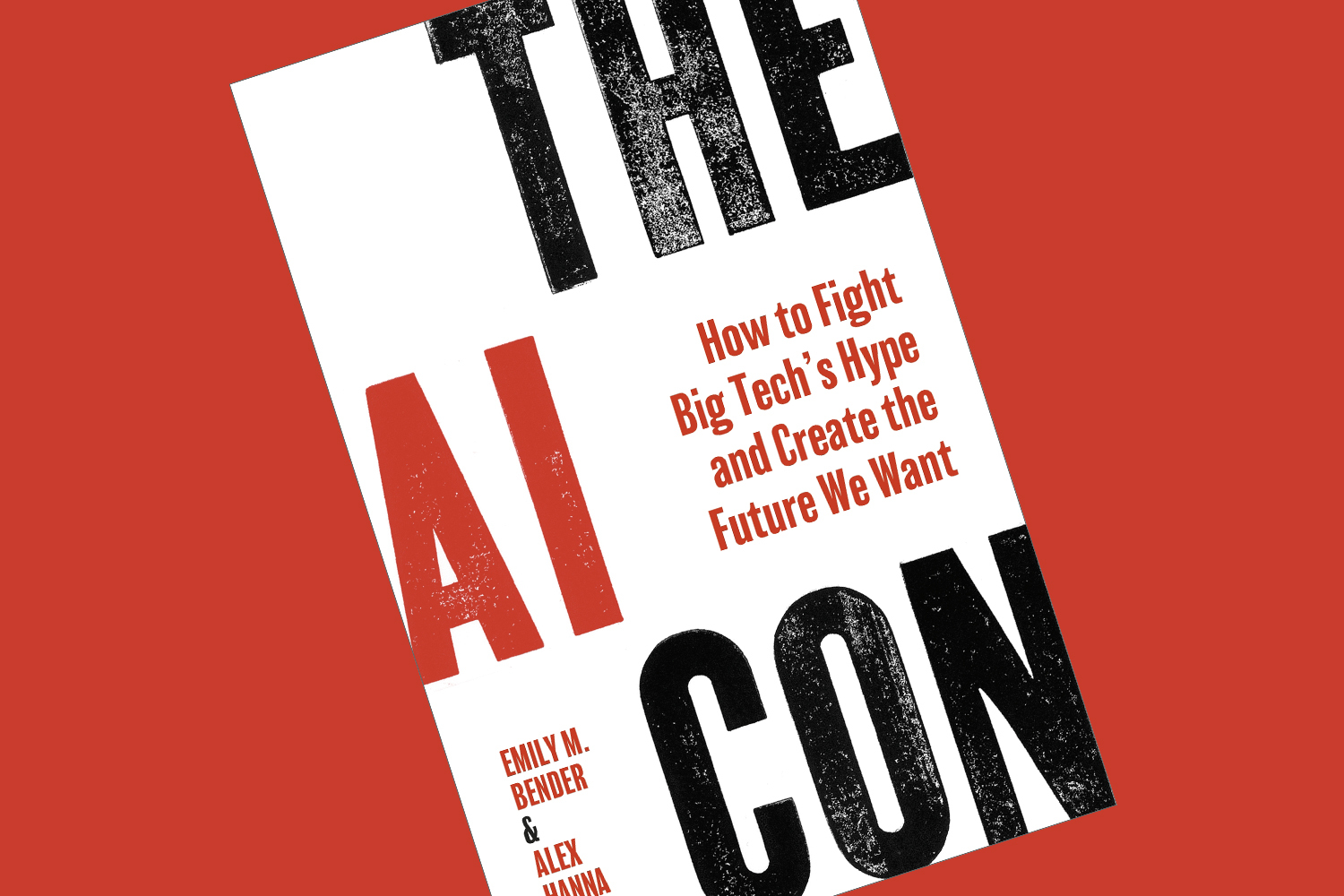
The AI Con
By Emily M. Bender and Alex Hanna. The Bodley Head, £16.99. Designed by Bonni Leon-Berman. Reviewed by John L. WaltersPacked with information, The AI Con pours cold water on ‘AI’ hysteria, while drawing attention to the tech’s environmental and ethical implications
This smartly written, often funny book throws a refreshing pail of ice-cold water over the most feverish predictions for ‘AI’, writes John L. Walters. Though authors Bender and Hanna take machine learning seriously, and have the academic qualifications to back up their criticisms, they don’t take the new tech bosses and venture capitalists seriously at all. The book’s rollicking tone has its origins in the podcast Mystery AI Hype Theater 3000; the narrative whips along in seven tightly edited chapters. With extensive footnotes and an index, it clocks in at just 276 pages, and I can recommend it to casual, non-academic readers without hesitation.
Several books deal intelligently with this exploding field, including Supremacy (Parmy Olson), Taming Silicon Valley (Gary Marcus) and Karen Hao’s Empire of AI, full of eye-opening reportage that makes it a complementary (if much longer) companion to The AI Con. But the last book is one of the best places to start, full of information that will help readers formulate their own critiques of this twisting, turning contemporary phenomenon.
The AI Con faces squarely the environmental and ethical concerns to consider when using such services. ‘You would think that people ostensibly concerned with the future of humanity would be working as hard as possible to build political will to decarbonise,’ write Bender and Hanna in chapter 6, ‘I’m Sorry, Dave, I’m Afraid I Can’t Do That’.
‘Instead what we see is a mad dash towards ever-larger models that require increasing amounts of computation (and therefore energy consumption) to train and use – with real and measurable environmental impacts.’
Title screen for Mystery AI Hype Theater 3000, the podcast hosted by Bender and Hanna since 31 August 2022.

The AI Con went to press in late 2024, so it doesn’t cover the rolling revelations of 2025, including Chinese rival DeepSeek. The book’s timing is good, however, for the emerging wave of AI scepticism. Bender and Hanna make a distinction between so-called ‘AI boosters’ and ‘AI doomers’, stating that the latter merely add to the hype by exaggerating the importance and value of the sector, while ignoring its real and present threats to people and planet.
Many of the explanations of why ‘AI’ is best understood as a PR / marketing term come from the way the authors distinguish language from thinking. ‘Language is so central to our understanding of each other, that … it’s difficult not to imagine some humanlike mind behind it.’ (Bender, co-author with Timnit Gebru and four others of the celebrated paper ‘On the Dangers of Stochastic Parrots’, is a professor of linguistics.)
The reason for the scare quotes is that ‘AI’ has become a meaningless PR term, only useful when you are trying to raise huge amounts of capital. Bender and Hanna suggest we substitute phrases such as ‘mathy maths’ or ‘a racist pile of linear algebra’! Ultimately, they explain, it is more useful to talk about ‘automation’, and then to define precisely what human activities are being automated.
At its core, The AI Con is a plea for empathy, packed with information with which to fight back against those who would cheapen our humanity. The ‘Con’ of the title implies that big tech is perpetrating a ‘confidence trick’, but the term Bender and Hanna use more frequently is ‘hype’, and they demonstrate that the best way to rebut ‘hypetastic’ claims is to check the sources. (Their Mystery AI podcast has the tagline ‘along the way we learn to always read the footnotes’.) The book’s introduction references the work of early booster Marvin Minsky (1927-2016), who in a 1956 paper compared human beings to machines, and Joseph Weizenbaum (1923-2008), who in the 1960s was horrified to find his chatbot ELIZA was easily misunderstood, ‘and spent the rest of his life as an AI critic, noting that humans were not meat machines.’
Portraits of the authors. Emily Bender (left, photo by Susan Doupe) and Alex Hanna (photo by Will Toft).

The authors tackle specific areas in which tech is hyped: work, social services, art, journalism and science. There are gruesome statistics about self-driving cars and harrowing tales of the way AI tools require large amounts of hidden labour, presided over by companies such as ImageNet, Sama, Remotasks and Scale AI. ‘When executives are threatening to replace your job with AI tools, they are implicitly threatening to replace you with stolen data and the labour of over-worked, traumatised workers making a tiny fraction of your salary.’
Examples of AI used for policing, housing, social care and justice are similarly hair-raising, with many case studies from across the United States that exemplify what Bender and Hanna call the ‘ouroboros of AI hype’. They challenge oft-repeated claims that AI systems might accelerate scientific research (citing ‘Deep Thought’ in Douglas Adams’ satire The Hitchhiker’s Guide to the Galaxy), and noting that such tools are often promoted by people who barely understand how science is practised at human scale. ‘As with AI “art” … AI boosters think that science is only about ideas, rather than communities of practice.’
The final chapter, ‘Do You Believe in Hope After Hype?’, is a call to action to pop the hype bubble, with a useful checklist for ‘everyday resistance’ – questions to ask when AI invades your space. ‘The more we can pierce the cultural bubble that [Open AI’s] Sam Altman and his kind live in, the better we can upset the idea that the encroaching of these systems into every area of life is inevitable.’ There will be more books that probe and dissect this extraordinary era, but by writing this timely antidote to hype, in which exasperation is tempered with sharp humour, Bender and Hanna have performed a great service to culture, technology and the everyday people who look on Silicon Valley, and all its works, and despair.
John L. Walters, editor of Eye, London
See also ‘Ultra process’, by John L. Walters, Eye 107
‘Baked in’, by J-P Hartnett, Eye 107
‘Artificial idiot’, by Marian Bantjes, Eye 105.