
Winter 2026
Atomic everyday

Michael Collins’ mesmerising, technically perfect photographs of nuclear plants show interiors that are both mundane and frightening. By John L. Walters
The Nuclear Sublime by Michael Collins is a photobook of pictures that Collins took inside nuclear power stations, a slow-paced sequence of industrial interiors in which every element is in sharp focus. The spreads – captions on the left, pictures to the right – are interspersed with full bleed details, sensitively art-directed by Richard Krzyzak. Collins achieves a once unattainable depth of field in these mesmerising digital photographs through ‘focus-stacking’, exposing numerous frames in succession, each focused progressively further back. The separate frames are then compiled into a final, high-resolution image in which every part of the composition is rendered in pin-sharp detail.
Reactor Building, Chapelcross, No 2, 2022, which ceased operation in 2004. Top. Refuelling cavity, Reactor, Sizewell B, No. 2, 2023. This is the UK’s newest nuclear power station, in Suffolk, England.
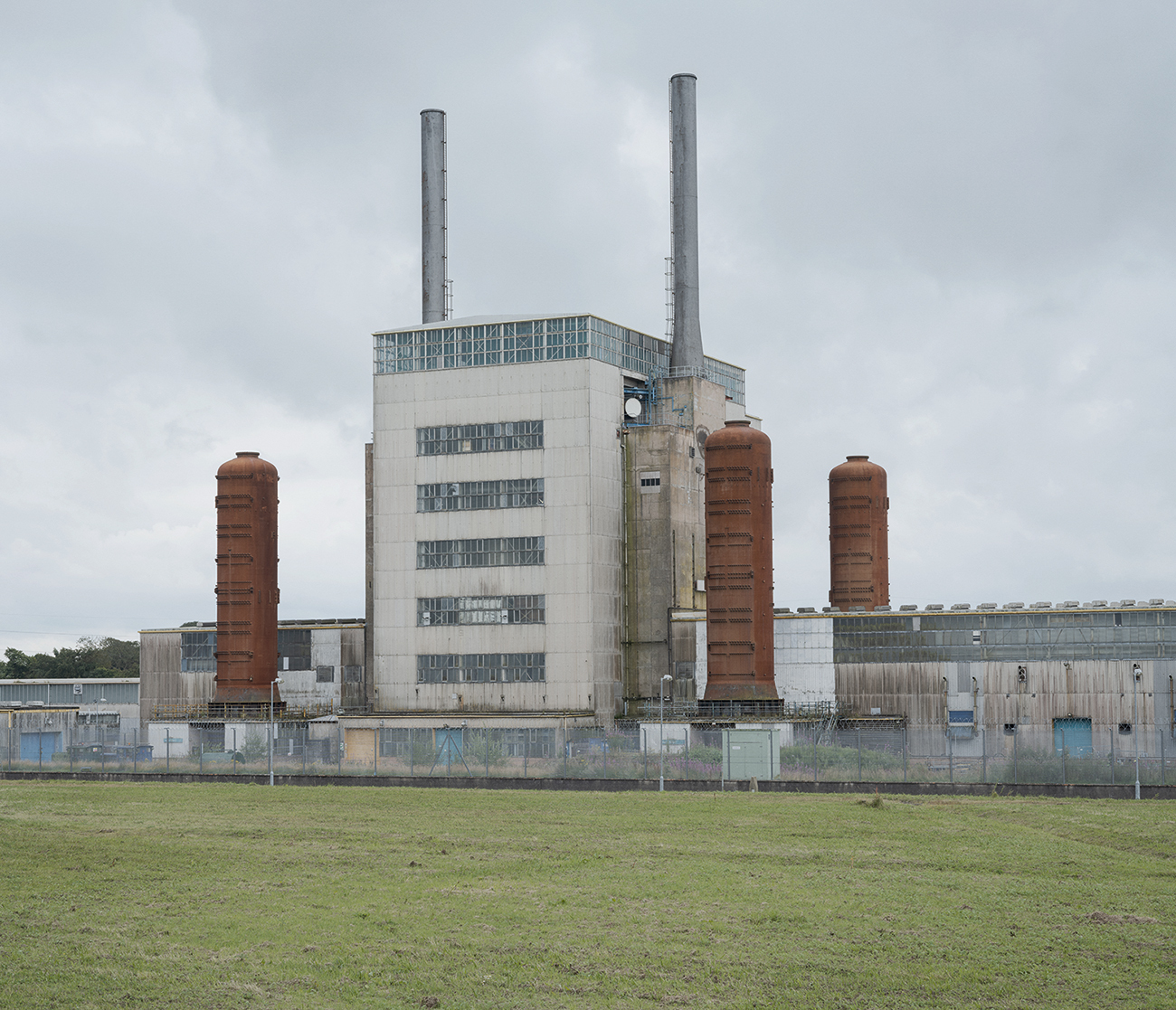
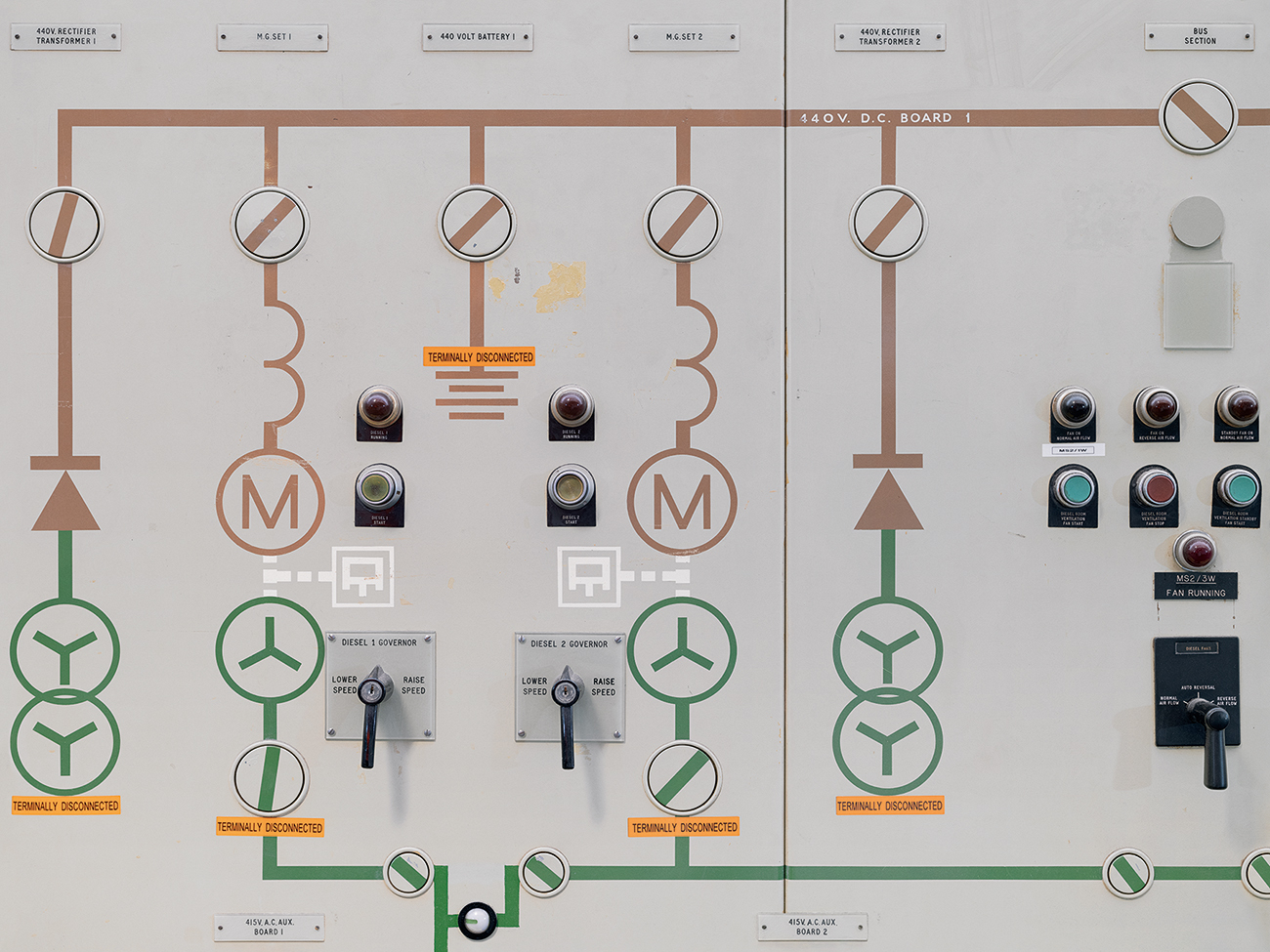
Colourful and unpopulated, the photos, yet to be exhibited at large size in a gallery, are the result of Collins’ patient, challenging visits to a host of mostly British nuclear sites. No human figures cross his compositions, though their traces are ever present. Some scenes imply that drama is about to unfold, like a set for an opera about Three Mile Island. Others are more humdrum, with an office chair or abandoned Henry vacuum cleaner; or weirdly chic, like a Lynchian film set in an underground club. The typography of arcane analogue controls has its own graphic fascination, as does the patterning of symbols, buttons, lights and levers. The oblique icons shot in the main control room of Sizewell A, by the Suffolk coast, are complemented by orange stickers that state ‘Terminally disconnected’ in narrow capitals. The turbine hall and adjoining structures at Sizewell A were safely demolished in the spring of 2025.
Turbine Hall, Chapelcross, No 1, 2022. This space contained eight turbines, each painted an individual colour and manufactured by C. A. Parsons & Co. According to a report from the Nuclear Decommissioning Authority (NDA) the final site clearance will not take place until some time after 2089.

The manic, almost whimsical repetition of valves, controls and meters in ITER, the ‘International Thermonuclear Experimental Reactor’ in Saint-Paul-lès-Durance, southeast France, seem adjacent to dystopian science fiction, the product of a mind like that of a novelist or illustrator, say William Gibson or Tom Gauld.
Collins, also an articulate writer about his profession, has long had an interest in ‘Record picture’ photography. Most of the essays in Blind Corners (2025), a superb collection of his writing published by Notting Hill Editions, deal with examples of what is not so much a genre, more a vast tract of human experience. Victorian pioneers used plate cameras to survey bridges, buildings, landscapes and volcanos, from the quotidian to the sublime. Present-day smartphone users take photos to record meals, meters, malfunctioning locks, parking locations and parties. Somewhere in between lies the rich tradition of industrial photography, which broadly embraces the work of Margaret Bourke-White, Bernd and Hilla Becher, Maurice Broomfield, John V. Robinson and Eye regular Philip Sayer.
Control Room, Reactor 2, Dungeness A , 2022. According to the NDA, demolition of the Kent power station, which stopped operating in December 2006, will not take place until after 2087.
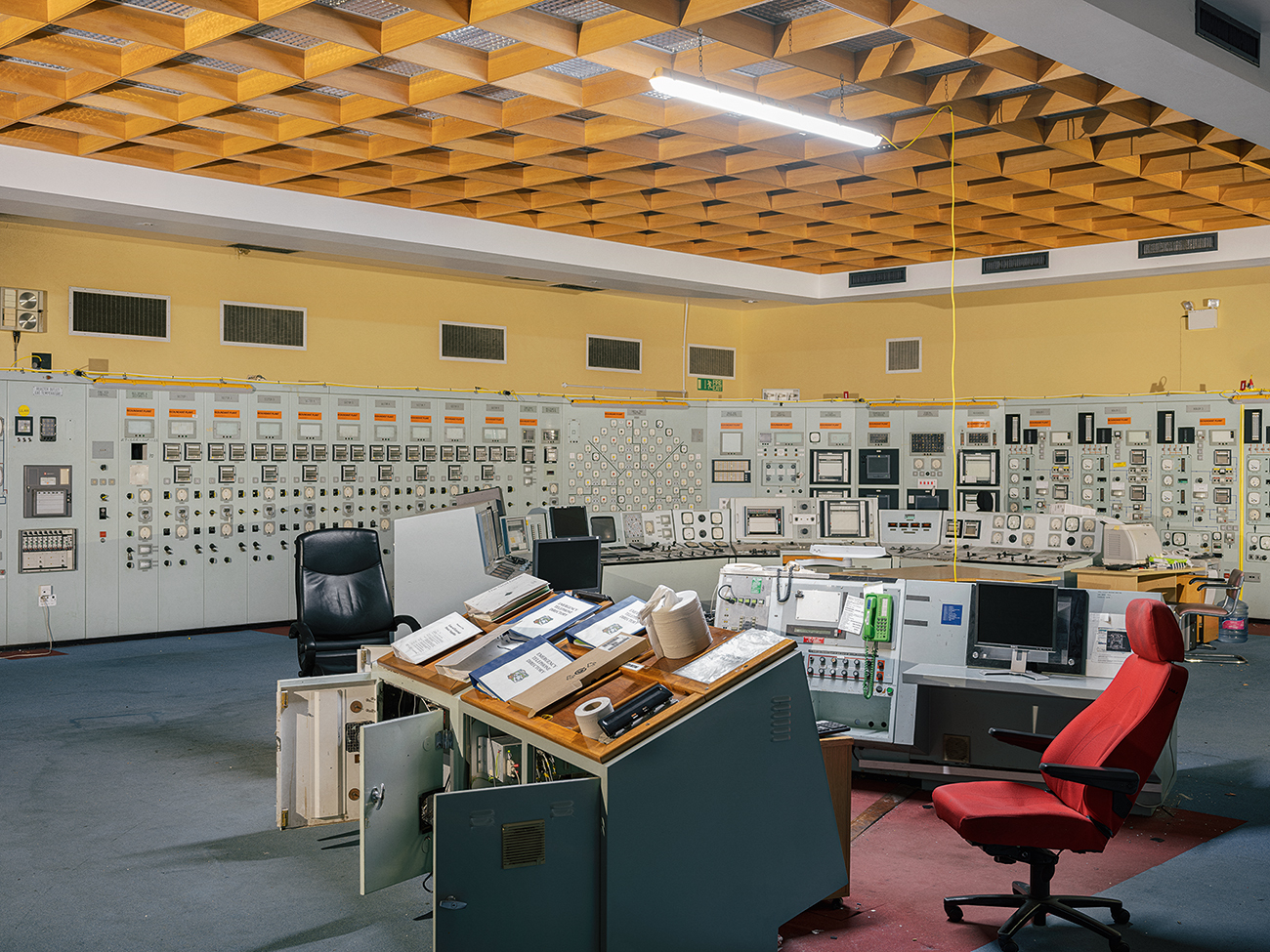
Collins’ nuclear sites are everyday places to those who work there, but for the rest of us they have an ugly beauty, with shapes and colours we rarely see, our perception inevitably coloured by our knowledge of the invisible dangers inherent in being there. His description of the lengthy security procedures required for entry have a chilling banality. There is no indication of what these places sound like, though an active imagination might conjure a hollow aura of anxious nothingness, an anechoic chamber that amplifies one’s own heartbeat or nervous system. Yet these deep-focus photos imply a quietness, perhaps a hum, the wind, the cries of giant seagulls, the creak of doors and floor surfaces as both workers and visitors are shepherded through the security and safety routines. Nuclear power stations are typically built far from places where many people live, and close to sources of water.
Such a mix of the claustrophobic and the mundane is reminiscent of the way film and TV designers use the look and feel of abandoned industrial sites as visual metaphors for dread and moral decay in works such as Breaking Bad, Slow Horses, Chernobyl (of course) and Alien. Some places have Brutalist grandeur. Others are so nondescript and messy they could be our own cellars, tool sheds and garages; alternatively a tyre shop, warehouse or Kwik Fit.
Some sites that Collins photographed, such as Sellafield in Cumbria, northwest England, and Dungeness A, on the Kent coast, have ceased generating electricity. Though it was safe for him to work in most areas of the UK’s active nuclear power stations, he could only shoot the reactor at Sizewell B (in Suffolk) during ‘outage’, routine maintenance.
The beguiling blue water of Sizewell B’s refuelling cavity hypnotises the viewer in a way that is almost magical. Collins explains that the colour is created by Cherenkov radiation, electromagnetic radiation that occurs when a charged particle passes through water at a speed greater than the phase velocity of light in that medium: ‘The electromagnetic disturbance causes a shock wave of distinctive blue light.’ This is the most intoxicating example of his term for this body of work: The Nuclear Sublime.
In a lucid introduction, Collins discusses the arguments for and against nuclear power. On the one hand they provide extra ‘fuel security’ and have no carbon emissions. On the other, there are the problems of waste and the risks of accidents. While the nuclear energy industry is young, the challenges of dealing with plutonium-239, with a half-life of 24,000 years, are hard to ignore, given the lack of long-term planning that Collins declares to have already led to ‘rising temperatures, melting glaciers and continuously rising sea levels.’ These stately, disquieting photographs articulate the human race’s ability to set itself unsolvable problems. All as a matter of record.
John L. Walters, editor of Eye, London
First published in Eye no. 109 vol. 28, 2025
132kV Grid Supply control panel, Main Control Room, Sizewell A, No. 2, 2022. This distributed and supplied electrical power for the nuclear power station, which ceased operation in 2006.
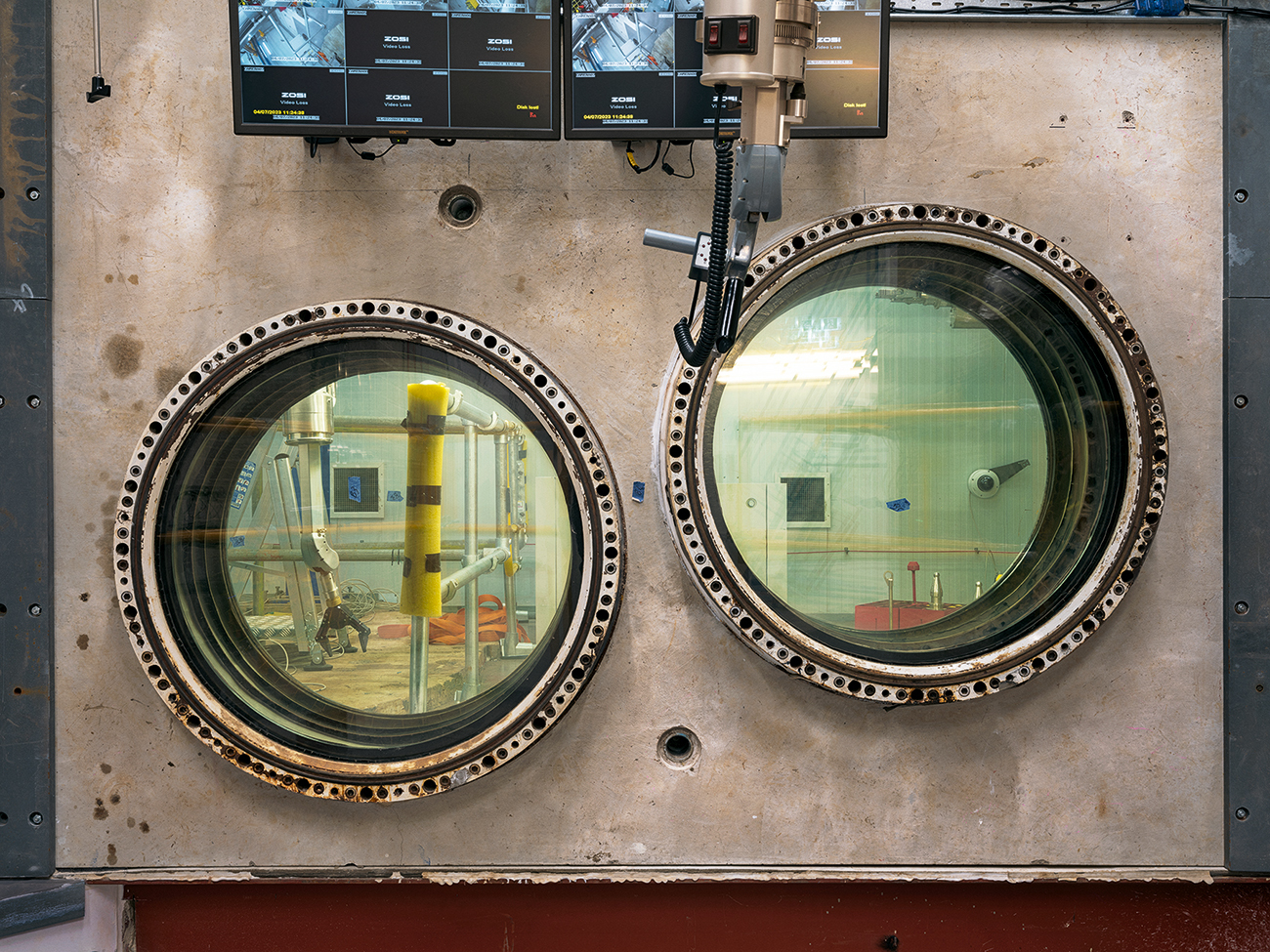
Master Slave Manipulator (MSM), Dragon Reactor, Winfrith, Dorset, 2023. The window on the left shows the slave end; the right shows a fuel spike box, with a spike protruding from the top. The MSM is used for packing fuel spikes and handling radioactive material for analysis.

Eye is the world’s most beautiful and collectable graphic design journal, published for professional designers, students and anyone interested in critical, informed writing about graphic design and visual culture. It is available from all good design bookshops and online at the Eye shop, where you can buy subscriptions and single issues.