
Winter 1994
Not so quick on the QuickDraw
Software: Apple's extension
András Benedek on Apple’s extension
Some five years ago, Apple announced its intention to update its graphics imaging software QuickDraw to provide new colour, graphics, text and printing functions. The fruits of its efforts emerged in late September with the launch of QuickDraw GX, the main component of which is an optional extension of System 7.5.
QuickDraw GX improves on the Macintosh’s typesetting capabilities in two ways. First, the extension contains improved line layout routines and supports the display and printing of vertical as well as horizontal text, of use for languages such as Arabic or Kanji. Text can be set right to left, left to right, or vertically, and type with different reading directions can even be displayed on the same line.
Second, Apple has introduced an improved version of its TrueType font format. QuickDraw GX fonts re-introduce many of the typographic refinements lost to Roman setting in desktop publishing and can cope with the larger character sets of many non-Roman languages. QuickDraw GX fonts can accommodate over 65,000 characters or ‘glyphs’ (representations of characters) as compared with the maximum of 256 glyphs in PostScript and TrueType fonts. A single GX font can therefore contain all the characters present in the Roman, bold, italic, bold italic, condensed and extended versions of a typeface, together with their associated lining and non-lining numerals, ligatures, diphthongs, small caps, fractions, swash and alternate characters, ordinals, superior and inferior characters, ornaments and flourishes.
QuickDraw GX fonts have been endowed with a degree of ‘intelligence’ through embedded instructions which automatically substitute ligatures, diphthongs and other characters without causing problems for spelling checkers. The faces have the variable characteristics of Adobe’s Multiple Master fonts, but the character style, weight, width and so on can be changed directly on the page without leaving the application, providing the immediacy of design lacking with Multiple Master fonts.
Take the example of typing the word ‘Caesar’s’ using Apple Chancery, one of the fonts supplied with System 7.5. With the options for the automatic substitution of ‘Common ligatures,’ ‘Diphthongs’ and ‘Swashes’ selected, the characters shapes change as each letter is added, and so on. ‘C’ followed by ‘a’ produces an ‘a’ with a swash. When the ‘e’ is typed in, the swash ‘a’ and the ‘e’ become the ‘ae’ diphthong with a swash, which disappears when the ‘s’ is added, and so on. Such variations may appear archaic and precious, but are essential for the setting non-Roman languages such as Arabic and Hindi, where changes in characters shape according to context are essential.
But there are many hurdles to be overcome before QuickDraw GX fonts achieve the widespread usage they deserve. First is creating enough of them. Font design is a time-consuming and painstaking process with uncertain financial rewards, so few type designers today embark on new faces on a speculative basis. The advent of new technology, however exciting, provides insufficient motivation – after all, relatively few Multiple Master fonts have been produced.
Creating a QuickDraw GX font which exploits all the possibilities is a mammoth task. The fonts supplied with System 7.5, which employ only some of the options, have with the exception of Tekton from Adobe been created or commissioned by Apple. Skia was designed by Matthew Carter and Hoefler Text by Jonathan Hoefler. Linotype-Hell is about to release the basic Laserwriter set of 35 fonts in QuickDraw GX format and plans to increase this number to 75 by the end of the year. The Font Bureau has Millennium and Giza in the pipeline.
Then there is the lack of applications that support QuickDraw GX and of cross-platform compatibility with Microsoft’s Windows. The only application available at present is a simple word-processing program from Apple called GX Write, though a page-layout application called UniQorn is under development by UK company Softpress and a new version of ReadySetGo is promised from Manhattan Graphics. Corel Systems Corporation in the US started work on a drawing application, but this was abandoned earlier this year.
In addition to the QuickDraw GX version of Tekton, Adobe has a number of other QuickDraw GX fonts under way, including Adobe Garamond and Caflish, but has no immediate plans to support QDGX in Illustrator or PageMaker. Altsys is not aiming to develop Freehand to support QDGX, though a spokeswoman stated that, ‘Fontographer has always been the market leader and if the market demands it, we will support QuickDraw GX fonts.’ QuarkXPress appears to have no development plans, though Linotype-Hell is considering an extension to make Xpress compatible with QDGX. Companies such as Adobe, Altsys and Quark have much invested in the software engines of their applications, and replacing these with QuickDraw GX-based alternatives would result in loss of control of the development of their products. Should one such company release an application supporting QuickDraw GX and reap rich rewards, circumstances would change. At present, however, they are sitting on the fence.
Over the last couple of years the major application developers have been bringing out Windows versions of their Macintosh software, so the dependence of QuickDraw GX on the Macintosh goes against the grain. A spokesman for Microsoft claimed Apple rebuffed initial offers for collaboration, following which Microsoft chose to develop its own enhance font format, TrueType Open. Such conflicting plans will undoubtedly hinder the exploitation of QuickDraw GX. Linotype-Hell and ITC formed a consortium earlier the year with the aim of creating a cross-platform standard, but little has been heard of this since the merger of Adobe and Aldus.
The relative scarcity of fonts, the absence of support by any mainstream application and the lack of cross-platform compatibility do not bode well for QuickDraw GX. One ray of hope lies in the soon-to-be-released version of ReadySetGo, which will exploit the power of QuickDraw GX for the setting of non-Roman languages. It is more than likely, therefore, that QuickDraw GX will first take root and flourish in the Middle and Far East.
András Benedek, partner, Font Factory, Old Hatfield, England
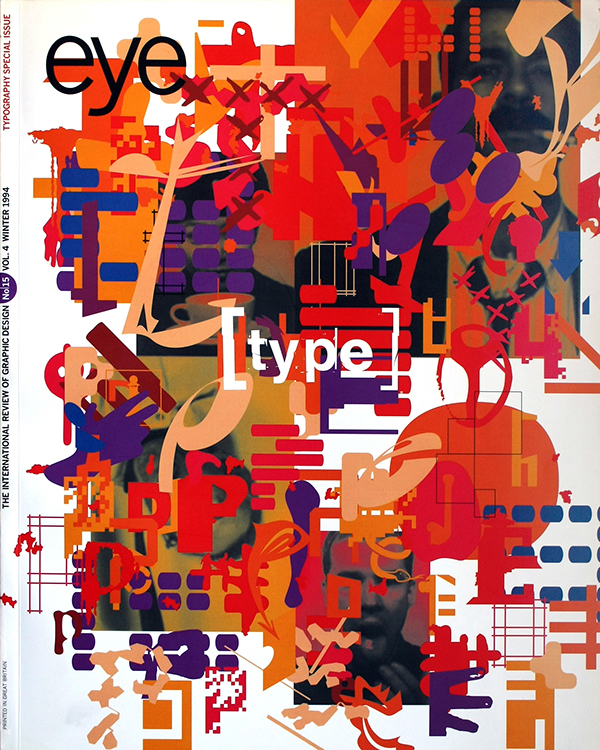
First published in Eye no. 15 vol. 4 1994
Eye is the world’s most beautiful and collectable graphic design journal, published for professional designers, students and anyone interested in critical, informed writing about graphic design and visual culture. It is available from all good design bookshops and online at the Eye shop, where you can buy subscriptions and single issues.