
Summer 2020
Sophie Thomas: Campaigner

‘You need a creative or design-oriented brain to figure out what the system is and how to shift it. Designers are good at this.’
Sophie Thomas studied graphic design at Central Saint Martins, followed by an MA at the Royal College of Art, and worked for Anita Roddick’s company The Body Shop. In 1998 she founded the design practice Thomas.Matthews (TM) with fellow RCA graduate Kristine Matthews. The agency quickly established a reputation within the fields of sustainable and ethical design (see ‘Don’t buy this’ in Eye 27). After Matthews left the company in 2008, TM helped establish the employee benefit trust Useful Simple Trust (UST) and became a social enterprise. For over a decade Thomas has been drawing attention to design’s role in combating pollution. In 2015 she launched the exhibition ‘Never Turn Your Back on the Ocean’, which highlights ocean pollution and vividly demonstrates the plastic problem. She has also worked with the ocean charity Common Seas on circular (as opposed to more linear) design solutions. Since her pioneering work on The Great Recovery (2012) – which aims to challenge issues around waste – Thomas has become an in-demand consultant, advising clients including Proctor and Gamble, Dr. Martens, Festival Republic and individual designers on ways to initiate more sustainable methods and re-think the design sector’s impact on the environment. Since 2010 Thomas has been design director for sustainability consultancy Useful Projects, part of the UST group of companies that shares offices with Thomas.Matthews. She also makes and exhibits glass art pieces (in collaboration with UK glassblower Louis Thompson) that draw attention to marine pollution. Her exhibition ‘Broken Ocean’ won a Collect Open Award in 2019.
Sophie Thomas is quick to point out that graphic design is only one aspect of the work done by her multi-disciplinary practice Thomas.Matthews (TM). As time has gone by, her efforts have become more focused on the ‘urgent narrative’ she believes is missing around companies’ carbon and material use.
‘I’m a big-picture person, a campaigner. It is vital that the work we do and the clients we have reflect the world we aspire to be in.’
At the time we met in early 2020, TM was working on a branding project for the Royal Scientific Society (RSS), an independent NGO and not-for-profit multi-disciplinary science institution in Jordan. ‘It’s such a privilege to work with the RSS,’ Thomas says. ‘At a more traditional design level, we have created a unique identity that takes some of the science research and translates it into a visual language. On an organisational level we are helping to build new departments to communicate the science and research impacts that the RSS has had over its 50 years of existence.’TM brings in system engineers to help clients interrogate their carbon use and the ‘whole life cycle’ of products in order to discover approaches that tackle the climate crisis. ‘When you look at the whole picture – gathering the data and understanding the processes – you can see where design can make a difference.’
Her communication work with footwear company Dr. Martens, for example, quickly moved into examining material flows, manufacturing and supply chains. She explains that corporate interest in sustainability is in part a response to customers’ demands. ‘Brands understand their influence very well,’ says Thomas. ‘Customers are now asking for transparency and authenticity and the brands must listen. If they don’t, it can be risky. If they take the wrong advice, their actions can be seen as “greenwashing”.’
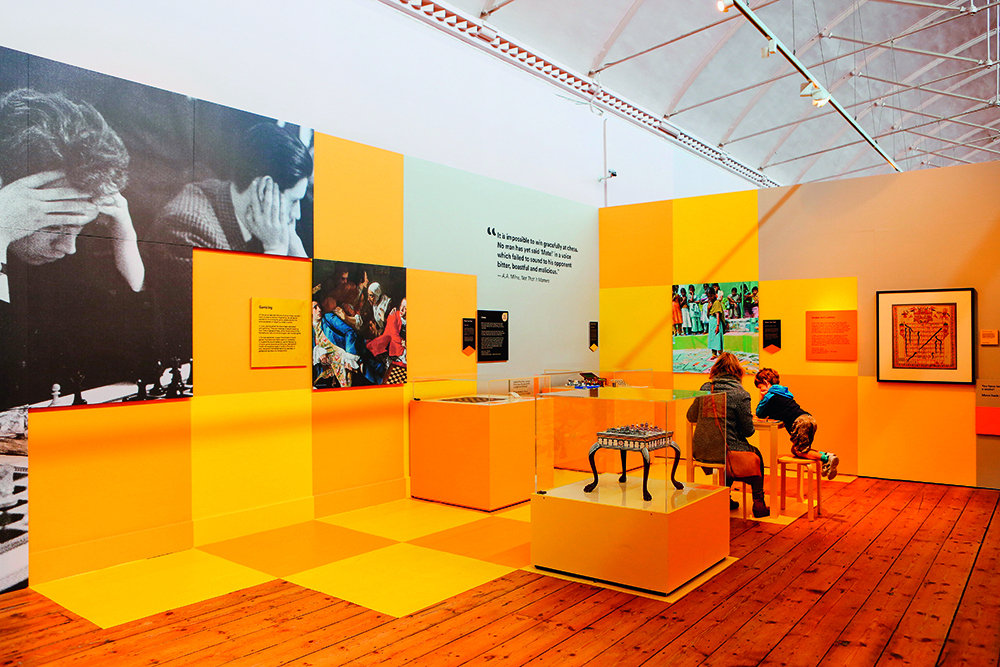
When TM works on wayfinding or exhibition design commissions, environmental concerns ‘are built in from the start’. The studio’s analysis of ‘design lifetime’ is always matched to the ‘material lifetime’ and waste is designed out as much as possible. For the Museum of Childhood’s touring ‘Game Plan’ exhibition in 2017, TM designed the whole build from components that could be folded, packed away, transported, and easily recycled. The material use was maximised with a series of text panels cut from inside the frames of the canvas surfaces, minimising waste.
Thomas admits that as a consultant, she can only give recommendations. (She says she oen reverts to the role of campaigner.) ‘It’s so much better than it was,’ she says. ‘Through collecting data and observing behaviour we can see where design can positively intervene.’‘We worked with Festival Republic, a big music festival, and went to see how people were actually behaving on the day. This type of observation with a focus on rubbish is known as garbology!’ Thomas notes that an event may have the right recycling bins on site, but people do not always know what things to put in which bins. ‘Not everyone understands materials the way designers do. I have interviewed people who call themselves “material illiterate”. This can cause massive problems when it comes to recycling and oen ends up contaminating bin loads of material.’
When it comes to finding solutions that respond to movements such as ‘plastic-free shopping’, Thomas recognises the complexities. For instance, swapping out plastic for paper or card alternatives is not always better ‘from a whole-life perspective’. The report ‘Fixing the system’ by Green Alliance estimated that switching all current plastic packaging on a like-for-like basis to other materials used in the UK could almost triple the carbon emissions. ‘This does not mean we shouldn’t do it, and clearly we have very big problems of pollution on land and sea,’ says Thomas, ‘but solutions must be at the bigger, system level. Material substitution is not a silver bullet.’ Confusion about what to do and anxiety about ‘brand risk’ can often lead to poor decisions made quickly and without proper understanding of the data. ‘When we face the quadrupling of global plastic production by 2050, we cannot stop at the small fights of rejecting plastic straws when we order our frappés. These must be a way into the bigger issues.’ (See also Thomas’s article ‘Living and decaying in the plastic age’ in Eye 94.)The conversation moves on to positive examples of media influence, in particular what Thomas and others call ‘the Blue Planet effect’ and the extraordinary way this acclaimed BBC series transformed public consciousness regarding plastic pollution. ‘Blue Planet really put marine pollution on the agenda. Out of the seven episodes there was only about a quarter of an hour showing the effects of plastic pollution. But the impact of those minutes helped open the way for mass Climate Emergency protests and brought swi, global support to movements such as Extinction Rebellion (see pp.116-117). It’s been transformative. The human impact on Earth was made clear.’
Thomas’s exhibition, ‘Never Turn Your Back on the Ocean’ was influenced by a trip to Hawaii in 2014. It continues to develop through her collaborations with glass artist Louis Thompson – their award-winning glassware exhibition ‘Broken Ocean’ featured waste glass and ocean plastic.
Creativity lies at the heart of what Thomas does, even when she is not designing: ‘I work with people who often talk about re-designing the system. I think you need a creative or design-oriented brain to figure out what the system is and how to shi it. Designers are good at this, easily adapting their thinking from micro to macro levels.’ An example she gives is her initiative The Great Recovery (2012-16), which she ran as part of her role as co-director of design at the RSA (Royal Society for the encouragement of Arts, Manufactures and Commerce). The Great Recovery aimed to look at ‘the challenges of waste and the opportunities around efficient and regenerative design, where materials retain their value for as long as possible (known as a circular economy).’
One of The Great Recovery exercises was analysing and mapping the entire lifecycle of a £300 laptop, looking at every one of its elements from source to assembly, through to the end of its life. So many of the small components had valuable materials that zig-zagged around the world several times before being thrown away and lost. Thomas is now working on Urge, a new project that aims to find effective responses to the climate emergency. ‘I heard Greta Thunberg speaking at the United Nations Climate Change Conference in 2019 where she said: “Our words are being heard but are not being translated into action.” It made me realise that those of us working in this field must now shift up a gear. We need paradigm shifts.’ Does she feel pessimistic about the future? ‘Sometimes I worry about the future and sometimes I am positive about it. I swing from eco-anxiety to alarmism to action positive. We should be scared, but in a galvanising way, rather than paralysing ourselves.’ Thomas’s energies are often directed towards fellow designers. Many younger designers actively seek out studios and employers who have a positive attitude towards combating climate change.
And in recent years she has often been approached by established designers who have come to realise that they are part of the problem and want to change.‘It’s not enough to make beautiful things,’ says Thomas. ‘You have to create something useful and sustainable, not leave a trail of waste behind you.’ What about day-to-day pressures in her own studio? ‘I have never known a designer who isn’t stressed. As part of being an employee benefit trust we try to make sure the whole team has a good work / life balance, no late nights, good wellness health support, yoga classes, lunches and mental health first aiders.’
Picking
up the conversation in May 2020, Thomas praises her team’s
resourcefulness in dealing with the Covid-19 lockdown: ‘Isolation
has taken remote working to another level, though we lament leaving
the Pantone books at the studio! The future is uncertain, but
creativity is fundamental to recovery, as it is imagination that will
take us on a path that leads back – not to business as usual, but
to a new and better normality.’
Portrait by Phil Sayer.
John L. Walters, editor of Eye, London
First published in Eye no. 100 vol. 25, 2020
Eye is the world’s most beautiful and collectable graphic design journal, published for professional designers, students and anyone interested in critical, informed writing about graphic design and visual culture. It is available from all good design bookshops and online at the Eye shop, where you can buy subscriptions and single issues.