
Monday, 9:00am
26 October 2026
Tech bro takedown
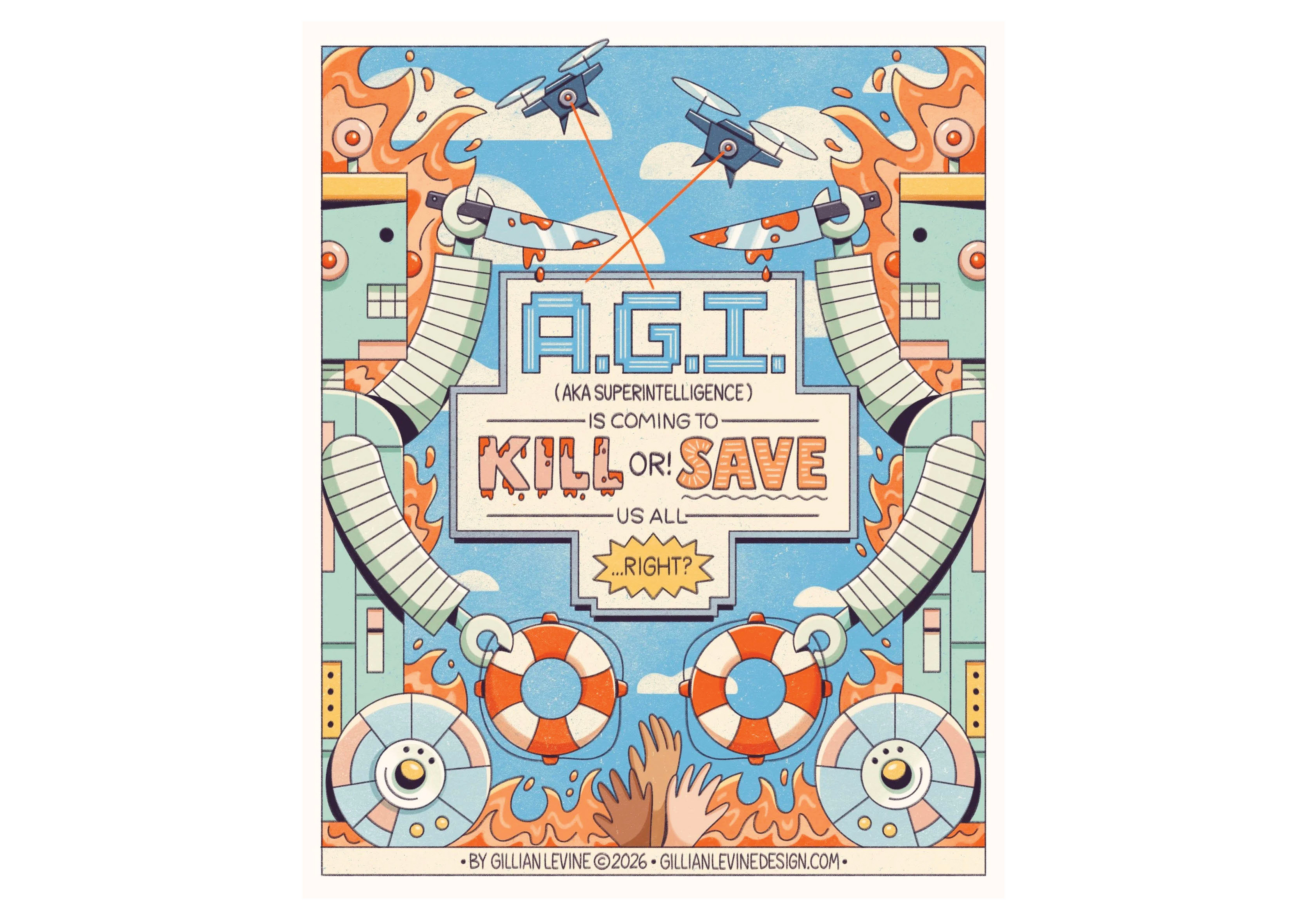
Graphic artist Gillian Levine has made a comic that mocks the absurdity of ‘AGI’ in thirteen pages. By John L. Walters
It is no surprise to come across a highly skilled creative professional who is critical of so-called ‘AI’. There are plenty of comedians, writers, illustrators and others who have made their opposition clear. Darrell Rees, for example, an illustrator and founder of the Heart agency, expressed his views at length when I interviewed him ‘Ultra process’, the article I wrote for Eye 107. And Steven Collins’s 2024 Guardian comic strip about Michelangelo using ‘AI’ for the Sistine Chapel remains one of the funniest items in the ‘early days’ of AI resistance.
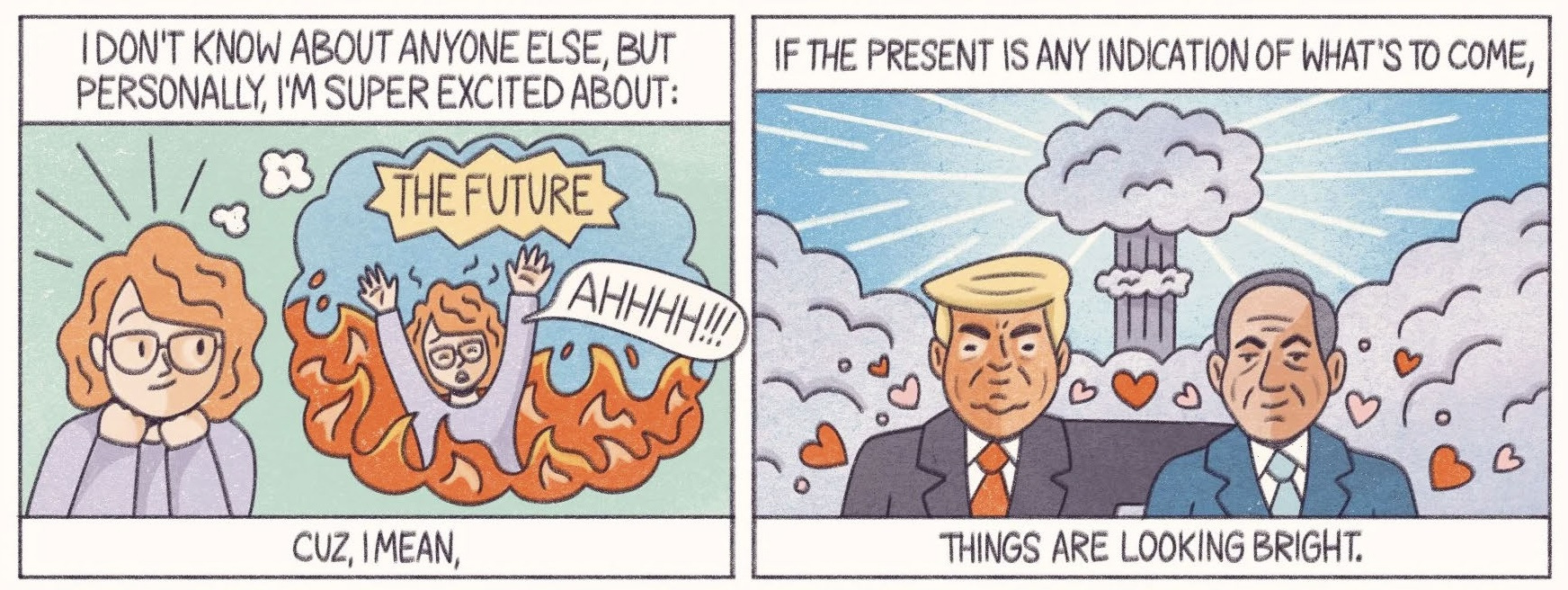
Panels from the first page of Gillian Levene’s comic.
Top. Cover.
However
Gillian Levene’s takedown of AGI (Artificial General Intelligence)1 is one of the sharpest, shortest critiques to date. (I discovered her
work via German designer Stefan G. Bucher.) The thirteen-page comic
(twelve pages plus cover) is well structured, comprehensively
researched and packed with facts.
‘Tear-out’ infographic sheet, which Levene first published on 11 June 2026 before publishing the whole comic the following month.
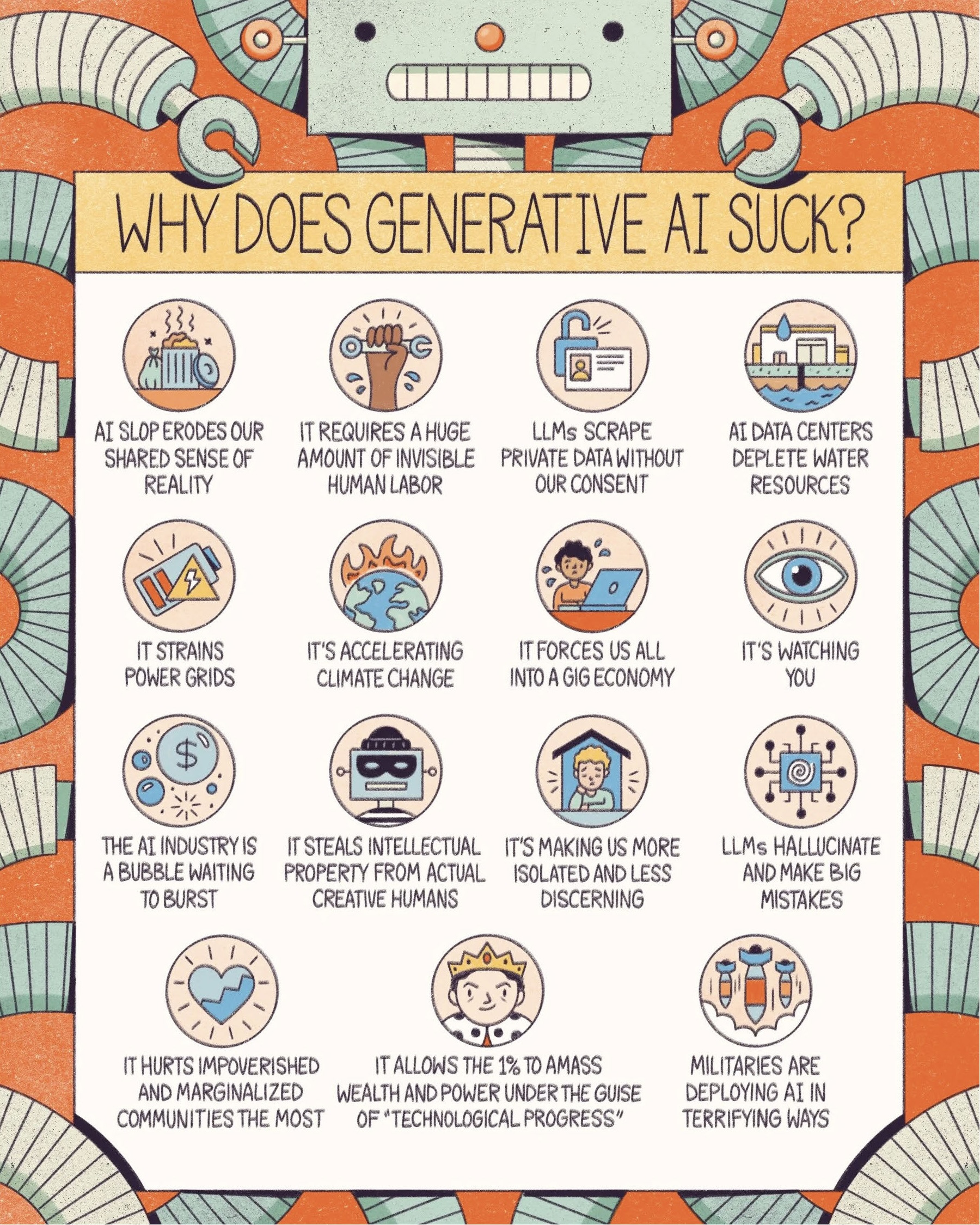
Levene deploys her diligent research with a light touch. The final version of her AGI comic, published on her website on 6 July 2026, includes a handy ‘tear-out’ info page (‘Why does Generative AI suck?’, above), complete with cool icons to represent different aspects of a complex issue that potentially affects everyone – not just ‘creatives’.
Panels from the second page.
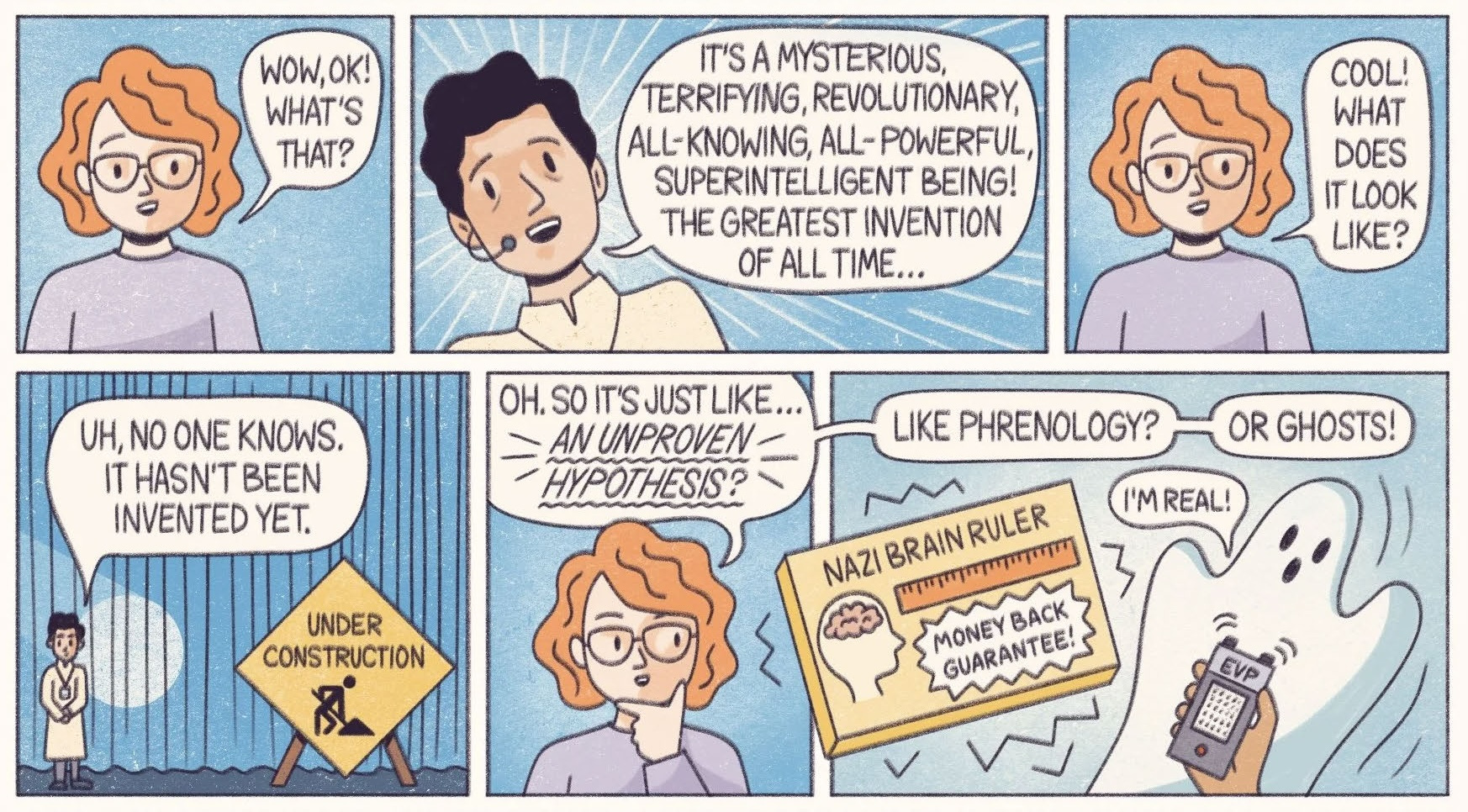
Levene puts herself in the narrative, asking awkward questions of a fictional white-clad tech evangelist character, as she explores the landscape of advanced tech bro thinking: ‘So it’s just like … an unproven hypothesis? Like phrenonlogy, or ghosts!’ The holy man answers by saying: ‘Ha … no. AGI is real. It just doesn’t exist yet. But when it does it’ll be the most glorious thing … or it’ll destroy all of existence.’
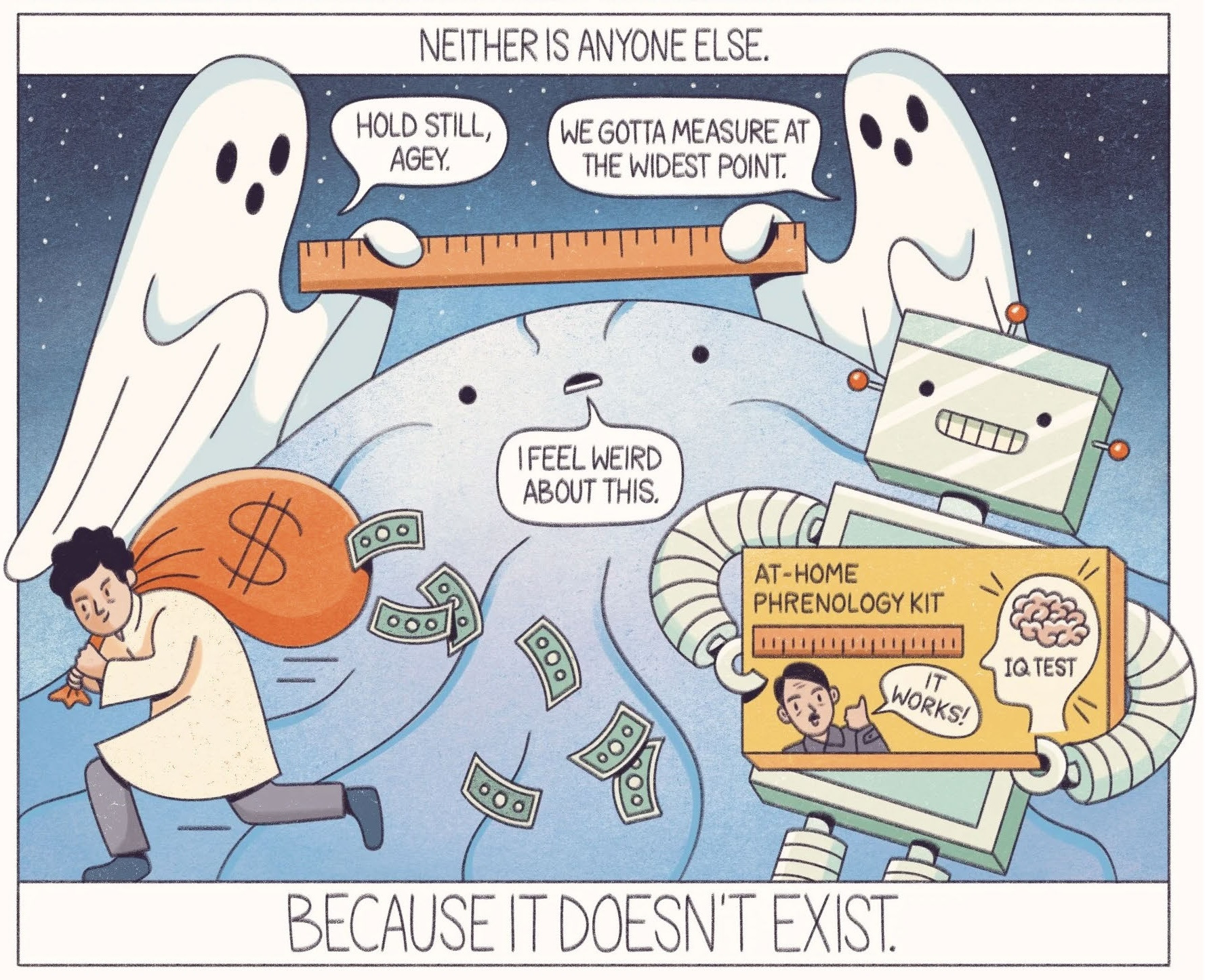
Increasingly frustrated, Levene’s curly haired avatar asks: ‘How can we trust that some future AGI will improve our lives in any meaningful way when the Generative AI that you’re forcing on us now is actively making the world worse?’ One the final page, AGI itself is portrayed as a phantom, a chimera, a cartoon ghost in a white sheet. She says: ‘I’m not an expert on AGI. Neither is anyone else. Because it doesn’t exist.’
Panel from last page of Levene’s comic, prefaced with ‘I’m not an expert on AGI. But then again …’
I asked Levene about the research that went into her comic.
Gillian Levene: I like to learn about what my mom calls ‘depressing topics’. I’ve been following ‘AI’ hype for a while because it’s affected a lot of my colleagues in the design industry and the environmental impacts are scary. It wasn’t commissioned. I wanted people – especially people using LLMs in their work – to have some insight into what this world is all about. There’s this mantra that’s like, ‘it’s coming and that’s inevitable’. But vibe coding doesn’t work very well, and people who are not in the design world are casually using it to organise their lives or write emails. Some people use it to generate images without realising what they’re doing.
John L. Walters When I started researching ‘Ultra process’ for Eye 107, I found there was little agreement among designers about how (or whether) one should use ‘AI’, but most illustrators were vehemently against it. They were seeing their work being taken away. But not many people understood the environmental impact.
Levene: I have seen a lot of rumblings (at least on the internet) about Gen Z not wanting to use it. And when people start to see the impacts on their communities and jobs, I think a lot of them are rejecting it – the cons outweigh the pros, I guess. But there are still tech evangelists who want to use it.
Panel from page four of the comic.
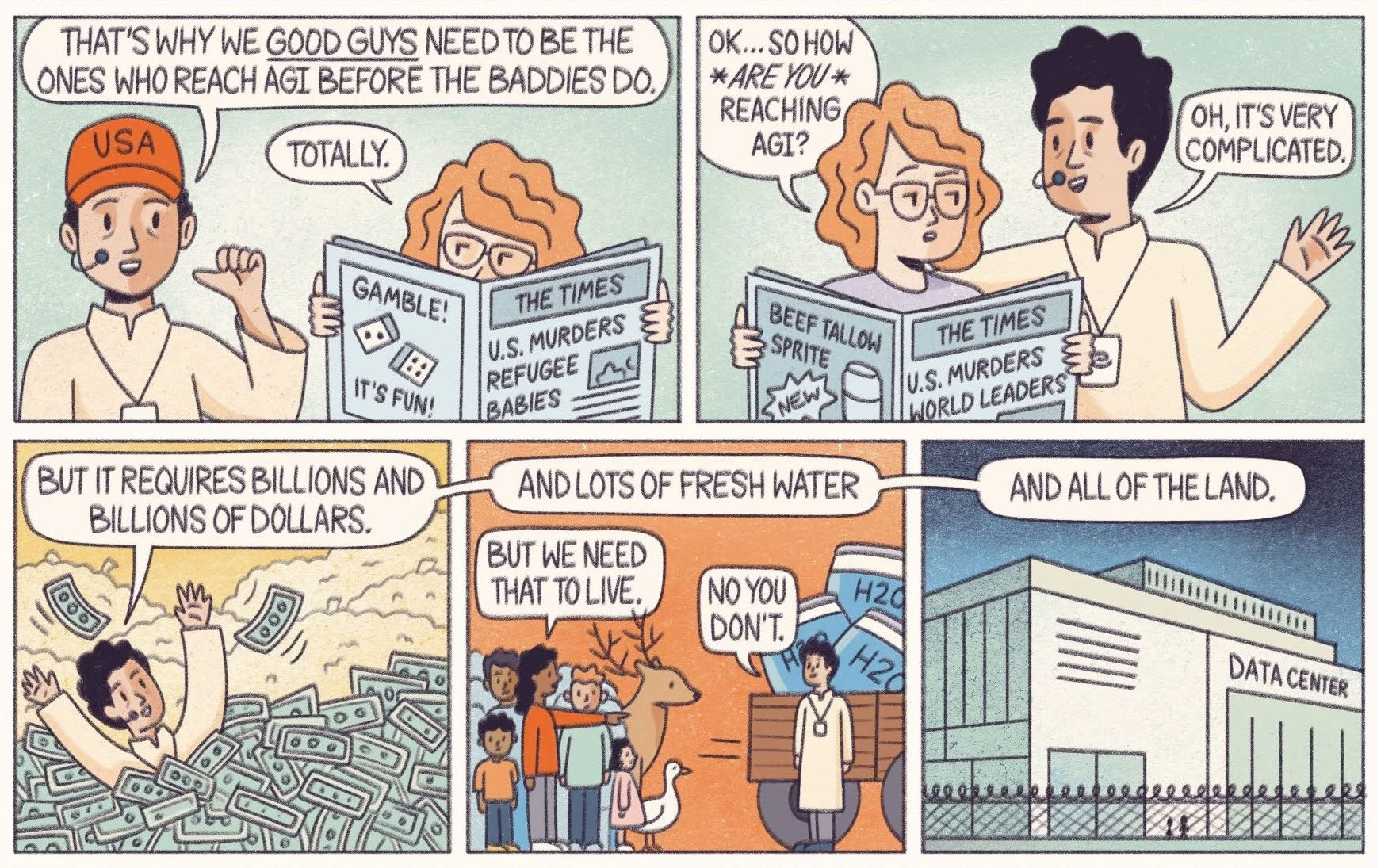
Walters: I liked the ‘evangelist’ character you created.
Levene: When I read Karen Hao’s Empire of AI I was struck by her characterisation of Sam Altman, the quote about starting a religion. But I didn't want to have to draw Sam Altman’s face on every page because I don’t like to look at him if I can help it.
Walters: I can't disagree with that.
Levene: He’s this nebulous white, wealthy tech bro. There are so many other people in that movement, like Marc Andreessen and Peter Thiel and Elon Musk, of course. I wanted to create someone who was a bland, sort of ambiguous white guy.
Walters: What did you read after reading Empire of AI?
Levene: I really like Ed Zitron, who’s a tech journalist. There’s a podcast called The Tech Report. And a book I actually read after I wrote the comic – More Everything Forever by Adam Becker. I wrote this comic and thought, ‘I hope I have this right because I'm not a journalist, but these are my gut instincts about how this industry works.’ Reading Becker’s book and learning all about the TESCREAL2 bundle, I was like, ‘Okay. I didn’t get it wrong.’
Walters: You say you’re not a journalist, but it reads like journalism, editorial design. You turned your thoughts and fears about ‘AI’ into a story with beginning, middle and end.
Levene: My background is graphic design, but I’m a self-taught illustrator and my first passion is creative writing. If my words and images convey what I’m trying to say, then I’m happy. To create something informative, I try to think of the most accessible way, and that’s usually through telling a silly story. With this project, I had the bookends: starting by introducing the ‘AI’ industry as a cult; ending with the idea that we shouldn’t be worshipping people who are trying to steal everything from us and leave us in the dust.
Walters: I enjoyed the visual metaphor of ‘AGI’ as a phantom.
Levene: I tried to think what some tech guy would imagine for a God they could worship. Would it be this amorphous being?
Walters: You also packed a lot of information into your fact sheet.
Levene: My previous job was doing SEO marketing, so I had to do a lot of infographics, taking information into bite-sized pieces and adding illustration. I thought that would be useful.
Walters: Are you a designer who illustrates or vice versa?
Levene: I usually say writer and illustrator. Sometimes designer.
Walters: What’s next? Are you cooking up other cautionary tales?
Levene: I want to do a comic focused on the specifics of the TESCREAL movement. The transhumanists, the effective altruists, the rationalists – morbid trading cards that describe the people and what they believe.
Walters: Sam Bankman-Fried will make an appearance then.
Levene: Yes.
And this guy, Eliezer
Yudkowsky,
who sounds like another person who shouldn’t have any influence or power. Other things I’ve been working include a story about my early
adulthood on Long Island and a horror comic, a
silly story about a town that punishes rude tourists with different
types of death.
Walters: Thank you Gillian, we will look out for those with great interest.
John L. Walters, editor of Eye, London
Endnotes
1. Not to be mistaken for Alliance Graphique International (AGI), whose members are the world’s leading graphic designers.
2. A term coined by Timnit Gebru and Émile P. Torres that stands for ‘Transhumanism, Extropianism, Singularitarianism, Cosmism, Rationalism, Effective Altruism and Longtermism.’ See paper published 14 April 2024.
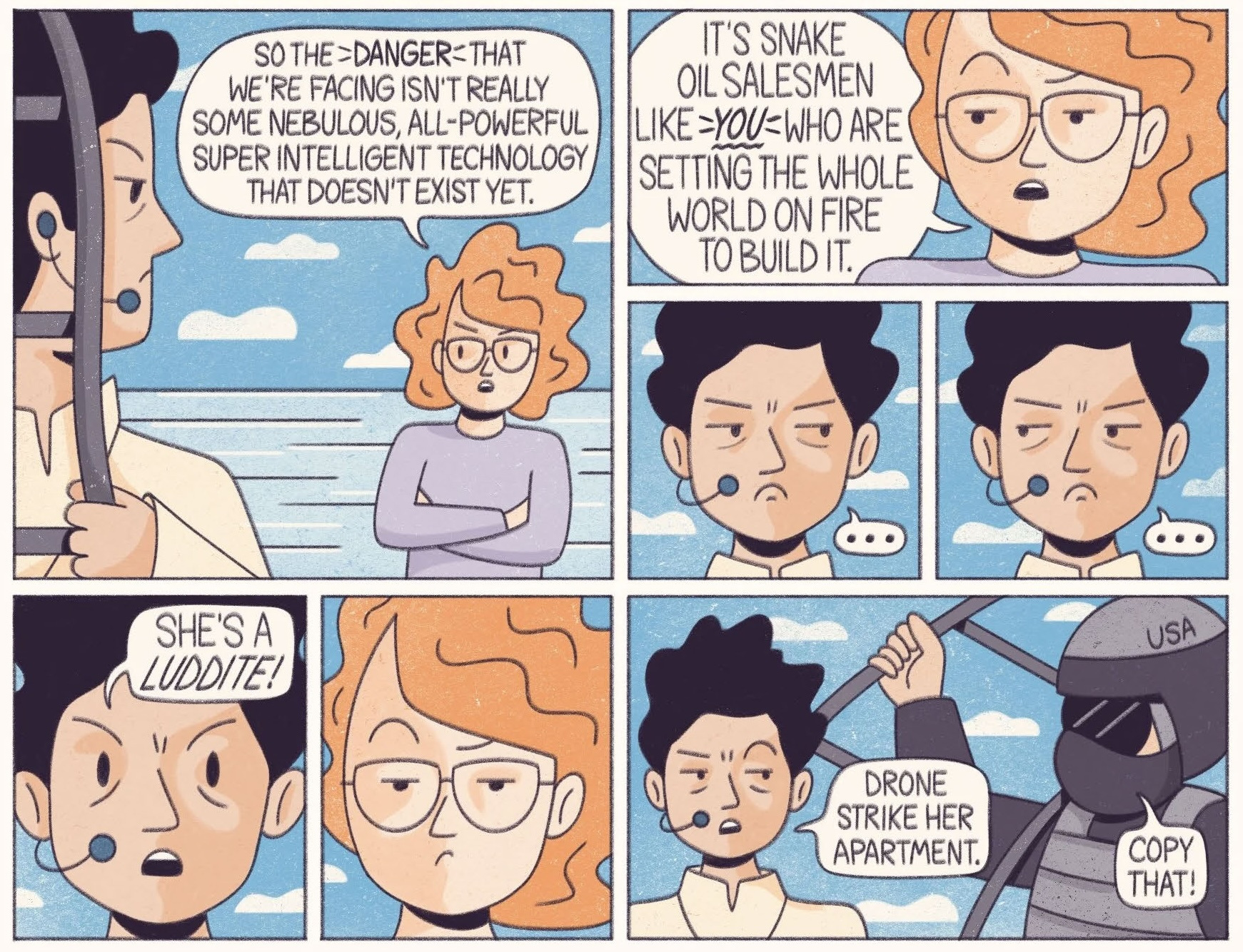
Panel from page ten of Levene’s comic, in which the tech evangelist shows his true colours.
Eye is the world’s most beautiful and collectable graphic design journal, published for professional designers, students and anyone interested in critical, informed writing about graphic design and visual culture. It is available from all good design bookshops and online at the Eye shop.